
The Problem Solving Operating System

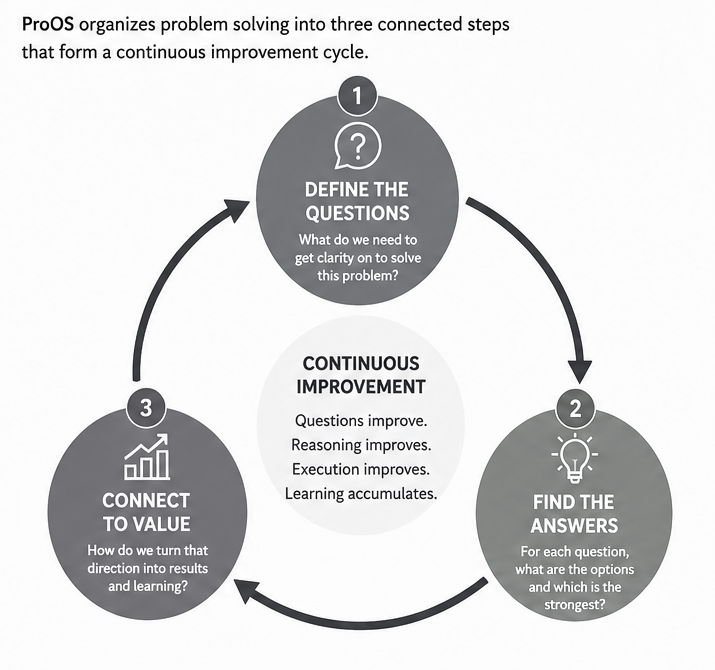
For most of history, coordination meant coordinating people. Now that intelligence is abundant, the real work is coordinating intelligence: turning what your people and your AI know into clear direction, shared commitment, and action. ProOS is how you do that, consistently, on any challenge.
The challenge changes. The operating system does not.
Step 1. Define the Questions. What do we need to get clarity on to solve this problem?
Step 2. Find the Answers. For each question, what are the options, and which is strongest?
Step 3. Connect to Value. How do we turn that direction into results and learning?
One system. Infinite challenges.
Grounded In Research Across Multiple Fields
ProOS is built on six requirements that any system for coordinating intelligence has to meet, drawn from decision science and developed with Dr. Mark Klein of MIT's Center for Collective Intelligence:
Focus on questions: start by defining the right questions, in the right order.
Enable broad contribution: surface valuable input from everyone, regardless of rank or personality.
Visualize the reasoning: make the thinking visible in a shared structure the group can build on.
Leverage collective judgment: use criteria and ratings to reveal which reasoning is strongest, and why.
Enable commitment to action: treat commitment as its own outcome, not an afterthought.
Turn experience into capability: capture what's learned so the next team starts ahead.
Two Simple Tools
Challenge Plans: the shared workspace and system of record for a single challenge. Questions, answers, arguments, direction, results, and insight, all visible in one place. We aren't documenting. We're creating clarity.
Playbooks: reusable problem-solving patterns. Challenge Plans help your team solve today's challenge. Playbooks help the next team solve tomorrow's faster.
Clear Roles, with AI as Advisor
Every challenge has a Decision Maker who owns the call, a Facilitator who owns the process, and Contributors who supply the reasoning.
AI joins the team as advisor, not author. It surfaces missing options and arguments and helps manage the work, but everything that enters the Challenge Plan passes through a human who chose it and owns it. You decide how much AI does, question by question.
What Makes It Work
Light structure. Enough to help teams think better together. Not so much that it slows them down.
Signal, not noise. Criteria and ratings turn a room full of opinions into a clear picture of which options are strongest, and why.
Buy-in, not consensus. One person still owns the call. Everyone is heard, and everyone can follow the reasoning, so the direction sticks.
One system, infinite challenges. The same approach works whether the problem is a market entry or a hiring plan.
You don't need new software or a big rollout. The operating system is the process, not the technology. Begin with one real challenge that actually matters, ideally with your leadership team.
Experience a better way to solve it. Then do it again.