
The Problem Solving Operating System



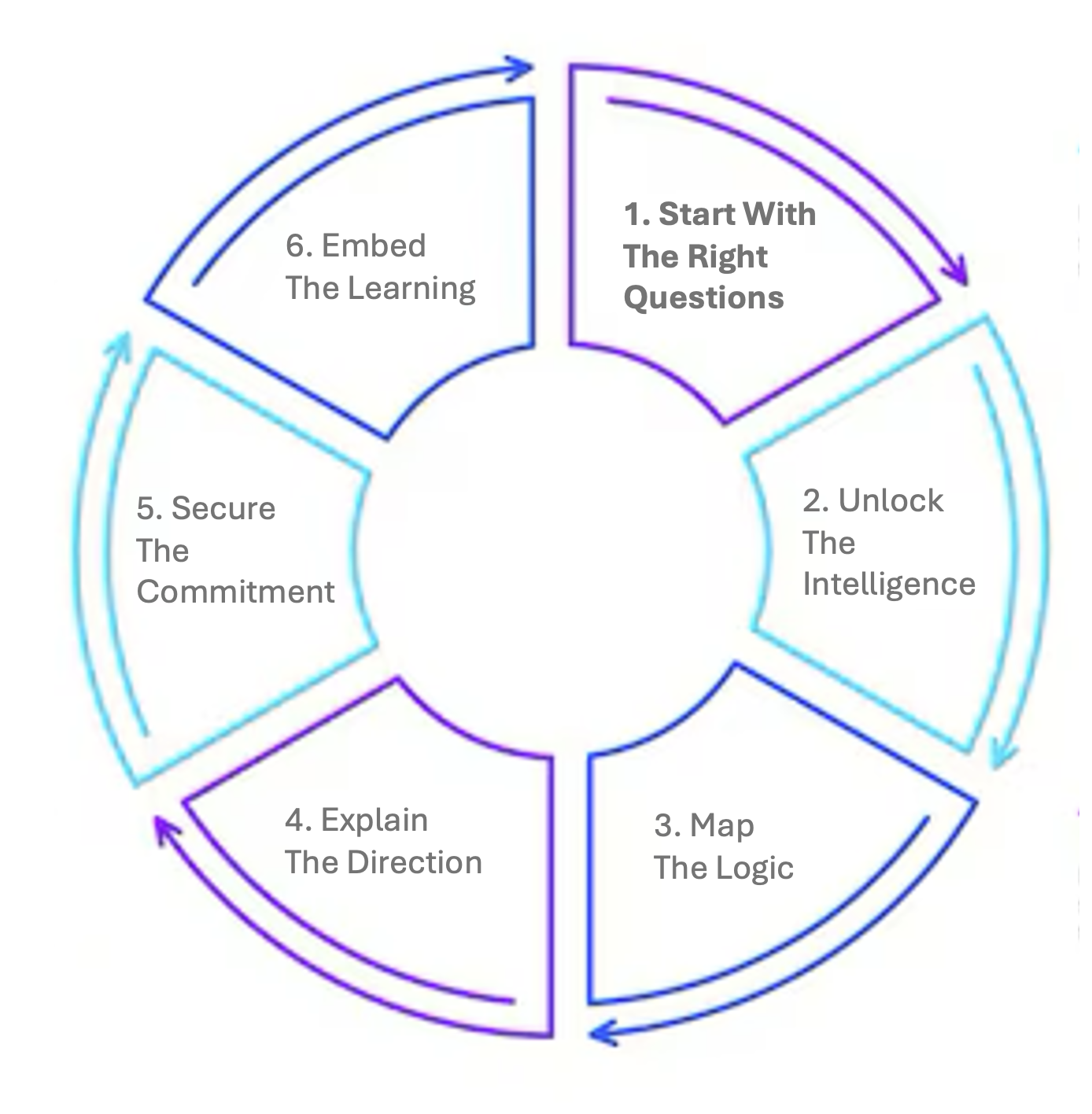
ProOS is a six-principle operating system for how your organization identifies, works through, and learns from its most important challenges. Developed in collaboration with Dr. Mark Klein of the MIT Center for Collective Intelligence, it is grounded in decades of research into how groups of people actually think and decide together.
Each principle addresses a specific friction point. Together they form a closed loop where every problem solved makes the next one easier.
ProOS also gives AI a clear and reliable role at every stage of the process. Most organizations are using AI tools without a consistent problem solving process, which limits their impact. ProOS provides a consistent, structured approach that makes AI more effective across every challenge, strategic and operational
The Six Principles
1. Start with the Right Questions
Most teams arrive at a discussion with a solution already forming. They debate the answer before they have defined the question.
ProOS starts differently. Teams define the full set of questions that need to be answered before any discussion of solutions begins. Past decisions and best-practice playbooks are consulted. The biggest failure point in problem solving is not getting the answer wrong. It is getting the question wrong.
2. Unlock the Intelligence
Hierarchy, seniority, and the dynamics of live discussion concentrate input among a small number of voices. Better thinking stays quiet.
ProOS separates ideas from identity. Author-blind input and shared team agreements create the conditions for every perspective to surface and be evaluated on its merits. The quietest person in the room often has the most important point. ProOS makes sure it gets heard.
3. Map the Logic
Rather than debating in the abstract, teams build a shared visual argument map. Possible answers are laid out. Supporting and opposing arguments are organized so the entire group can see the reasoning as it develops.
Progress becomes visible. Gaps become obvious. Clarity is no longer dependent on facilitation skill. It is built into the process.
4. Explain the Direction
AI meeting tools capture what was said. ProOS captures something more valuable: why a direction was chosen, what alternatives were considered, and what success looks like specifically.
Every direction comes with a rationale, a measurable target, a timeline, and assigned responsibility. Not because someone remembered to include it. Because it is part of the process.
5. Secure the Commitment
Most meetings end with implied alignment. Nobody pushed back, so execution begins. What follows is often slower and more contested than anyone anticipated.
ProOS replaces implied alignment with explicit commitment. Key stakeholders respond directly to the final direction before execution begins. The gap between a good direction and a good outcome is almost always an alignment gap.
6. Embed the Learning
Most retrospectives ask what went wrong in execution. ProOS asks a harder question: what could we have done differently in how we approached the problem itself?
Because the entire process has been documented, the retrospective can examine the quality of the thinking, not just the follow-through. Insights feed into living playbooks that make the next team smarter before they have asked their first question.
ProOS and AI
AI is delivering real value to individuals. The organizational opportunity is much larger and largely untapped.
When every team follows a consistent problem solving process, AI has clear and reliable points where it can contribute: helping teams ask better questions at the start, stress-testing reasoning in the middle, and surfacing sharper insights at the end.
The result is not AI replacing human judgment. It is AI augmenting collective human intelligence, systematically, at every level.
ProOS is the structure your AI strategy has been missing.
How Organizations Build This Capability
Experience
The fastest way to understand ProOS is to feel it working on a real challenge.
We facilitate sessions using the full methodology, bringing structure and collective intelligence to the challenges your team is already facing. Offsites, strategic planning, cross-functional alignment, high-stakes challenges.
Most organizations begin here. One session. One real problem. The experience makes the case better than any explanation.
Build
Once you have experienced ProOS, the natural next question is how to run it yourselves.
This is where we work with your leadership team to define your organization's version of the six principles, train internal champions, and begin building the archive and playbook library that makes every future session smarter than the last. Your leaders go deepest on the first principle and become the most effective internal champions for the full system.
Scale
Building a Problem Solving Operating System means embedding ProOS into how your organization actually operates.
This includes rolling it out across teams and functions, establishing a Center of Excellence to own and evolve the capability, integrating the software platform as the system of record, and building ProOS into how you onboard new people.
At this stage ProOS stops being something your organization does. It becomes the way your organization works.